Friday, 24 August 2012

SAAF Helicopter Force Preparation Camp and Competition - Airforce Base Swartkops

Oryx from behind
Flight Engineer working hard- Oryx 1211

Oryx passing by the older wiser Puma

East meets west-Mi24 (Hind) and an SAAF Oryx 


Hooking up the Pole- Oryx

Oryx 1211- 17 Squadron


Oryx

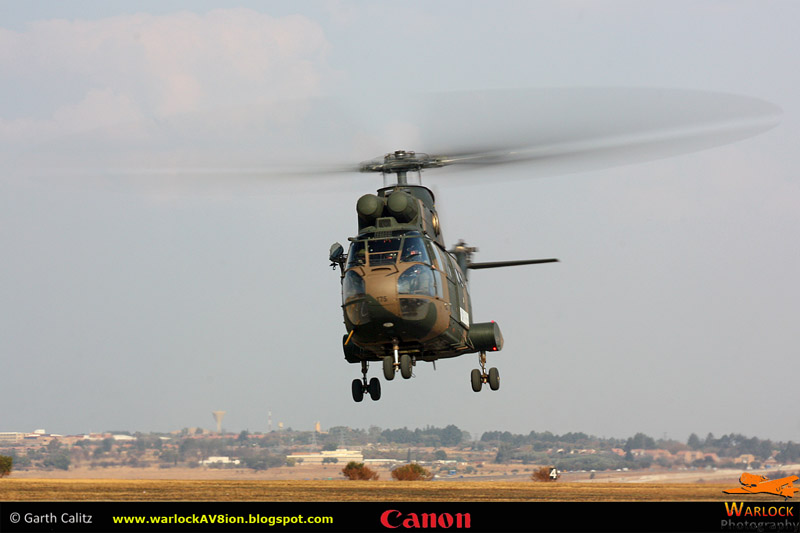
Puma with full Rotor Disk

Green Flag well done 

Bussiness end of Rooivalk 

Rooivalk

Rooivalk with the Airforce memorial in the distance

Keeeping it between the lines

Oryx in the hover

Augusta A109 

Allouette III no. 624 

Allouette III Flight Engineer Running through the checks

Oryx from 15 Squadron

SAAF Oryx 

Hard work keeping the weight between the lines- Oryx

Don't fall

Oryx and Rooivalk

Full rotor disk- Oryx

Dropping the rope- Eurocopter BK117


Eurocopter BK117 no 387 

13 ship chopper formation

The Stack - Alo II, Alo III, Augusta A109, Eurocopter BK117, Oryx, Puma and on the top the Rooivalk
BK117

Wonderful 

All lined up
Break formation


Tuesday, 21 August 2012

The Mirage F1CZ "211" Restoration Project

The Friends if the South African Air Force Museum have embarked on a project to restore a Mirage F1CZ interceptor, tail no "211", to a pristine static condition. the colour scheme chosen is the original delivery scheme, comprising of   Olive drab and Deep buff camouflage on th top and light Admiralty grey on the underside.  

"Barbie Mirage" in the Bush at Waterkloof
photo: Chris Oosthuizen
The original initiator of the project was Lt.Col Chris Oosthuizen, who headed the rescue of the aircraft from the scrap metal dealers, as she had been left out in the weather for approximately twenty years and was earmarked for destruction . The aircraft then, nicknamed "Barbie Mirage" due to the oxidation of the paint which left it an ugly shade of pink, was moved by tractor AFB Waterkloof  to the SAAF Museum at AFB Swartkops.
Lt.Col Oosthuizen accompanied by members of the newly founded SAAF Museum Photographic Club, started cleaning the pink aircraft and also sanded her in preparation for paint, the project unfortunately came to a halt late in 2011.

In August 2012 a group of enthusiastic members of the Friends decided to continue the project.

Photo: Wally Moll 
After consultation with Lt.Col Mike O'Connor the aircraft was moved to the parking area outside the Friends of the SAAF Museum's clubhouse. Where she will be for the duration of the restoration project


Photo: Paul Hoffman
Russell Dixon-Paver, Annelie Potgieter and myself undertook to photograph and document every missing piece of the aircraft, a report was compiled and sent to the 2 AC at AFB Ysterplaat as there was a Mirage F1CZ at the Museum in Cape Town that was in a much worse condition than 211 was. They were tasked to remove all the parts from the aircraft in Cape Town as she was about to be scrapped. In the interim 211 was cleaned and a ejector seat was sourced for her, the seat was installed. Front tyres have been sourced 60sqd as they use the same size wheels as the Mirage, all the rust on the Aircraft has been treated with a Rust converter.

Arthur Piercy with his Fiancé Gerda, father Cyril and mebers of
 the restoration team.
Much interest was generated by putting the project on social media, many ex 3 Squadron members  have made contact and asked to join the project, one of these is Arthur Piercy who's F1CZ was badly damaged by a missile shot from a Mig21, his drag chute had been damaged and had fallen off the aircraft and his hydraulic system had been damaged which left the breaks unusable. When he landed he had no way to stop the aircraft and it ran off the end of the runway, the nose and left main gear collapsed, somehow in the process the ejector seat deployed, the seat in a Mirage was never designed to by deployed while on the ground. Arthur was unfortunately badly injured and was left paralysed.
"211"s Current haome

Mr Andy Kiel General Manager of Elegant line road painters had offered to sponsor the paint and thinners for the repainting of the aircraft. After Mr Kiel approached Plascon  they decide to donate R60 000-00 worth of paint for present and future projects Mr Kiel also offered to donate sinage to the museum.

Cloth patches, Caps and Zippo lighters are being made available to all the members of the restoration team, they will all carry the logo as posted above (Patches and caps are on black and embroidered in gold lighter are silver and are engraved)

Friday, 17 August 2012

The Harvard Club Of South Africa


The Harvard Club of South Africa was officially launched in 1990 to coincide with the 50th anniversary celebrations of this majestic aircraft at Central Flying School at Dunnottar. The idea was however nurtured two years before by the membership of The South African Air Force Association (SAAFA), the plan was to use the Club to recruit members for SAAFA by getting interested parties together using their common involvement with the North American Harvard.

The Harvards were phased out in 1995 and were replaced by the Pilatus PC-7 Astra as the schoolmaster for the SAAF. During the change of guard Central Flying School was moved to AFB Langebaanweg in Cape Town. The interest in the SAAF Harvard’s from international collectors was overwhelming and it was feared that all the aircraft would leave our shores. In order to preserve this section of South African Aviation Heritage negotiations were entered into with the Department of Defence and SAAF senior command.

 The then Chief of the Airforce Lt.Gen James Kriel threw his weight behind the process and had the original request for four aircraft increased to ten. The lobbying then commenced the Deputy Minister of Defence , Wynand Breytenbach who happened to be an ex SAAF pilot who used to fly Harvards took the proposal to the highest reaches of government at the time. Approval was obtained in 1992 and between then and 1993 the Club was issued with range of Tail numbers that would later be available.

Finance for the preservation and operation of these aircraft was a frightening thought. The members of the Club were approached for financial support twenty-one members came forward and each donated R1000-00, with the funding taken care of ten Aircraft were chosen by WO1 AJ van der Walt and other members from the list of Aircraft made available by the SAAF.


The CAF officially handed over the first three Harvards to the chairman at a function held at AFB Swartkops early in 1994, these were 7028, 7643 and 7152.  The Aircraft immediately flown to SAA Technical at the then Jan Smuts Airport to be inspected and ultimately registered on the civilian aircraft register.

  
They were given the first of eleven registrations that were reserved for the Harvard Club these ranged from ZU-AOO to ZU-AOZ. Before the end of 1995 the remaining seven aircraft had been delivered to the Club and were also civilian registered.

An intensive research project was undertaken by Col Tony Smit, WO1 AJ van der Walt, Reg Rivers and AW de Klerk to trace and record the history of each Aircraft. These reports were forwarded to the National Museum Council, and the request was made that each aircraft become a certified National Heritage Item. The application was passed on the grounds that they were of major importance in the preservation of Aviation Heritage. The fact that they were now a national heritage item insured that they could never leave South Africa.

The Club now had Aircraft but didn’t have a home, They proceeded to lease a hangar at the Springs Airfield where they would commence operations these included introductory flights for the public. It was decided that one of the aircraft ZU-AOR original tail number 7059 would be painted in the official SAAF 75 colours to celebrate the 75th Anniversary of the SAAF. This was a gesture of appreciation for the assistance received in securing the aircraft.

The Club was moved to AFB Swartkops in 2000 and they are still located there to this day,  In the past few years aircraft have been repainted in different schemes used by the SAAF through out its history of flying  harvards, 7166 was painted in the scheme used for towing an Anti-Aircraft target. This is a very visible black and yellow chevron. 7028 was also repainted the colours used by 3 squadron.


On the 27th September 1996 tragedy befell the Club aircraft tail no. 7156 crashed in Pietersburg unfortunately both pilot and passenger were killed. A further two aircraft were involved in forced landings. In 2005 aircraft no 7152 had to land on the golf course in Stellenbosh due to an engine fire, she is currently at the Harvard  hanger 

awaiting repair. In 2007 no. 7592  had engine failure at fly-inn airfield near Rietvlei Dam and was forced to land, in the process she was badly damaged when she hit a tree. Thankfully in both incidents the occupants walk away without very serious injuries.


Photo : Ryno Albrecht
The Harvard Club currently operates six aircraft, 7166, 7028, 7643,7024, 7306, and 7059 still relies on the funds generated by introductory flights and formation fly pasts for its existence.
The club has a very proactive program to promote aviation awareness amongst the youth, many young ground crew have gone on to have very successful careers in aviation.

The Harvard Club ground crew are often requested to assist in airshows around the country as Marshall's, this is a testament to the quality of training they receive.